
Wednesday (2025/12/10) Download PDF here
The AI Revolution is Visual: How Text-to-Video Tools Change Everything for Nepali Creators, and 3 Free Tools to Start Today
For years, creating high-quality marketing videos, complex animations, or short films required huge teams, specialized equipment, and prohibitive budgets. That barrier has just been shattered.
The latest breakthroughs in Generative Artificial Intelligence (AI) mean you can now type a simple idea—for example, "A busy market street in Kathmandu, filmed in the style of a 1970s movie with a shallow depth of field"—and the AI generates the finished video instantly [2].
This shift moves AI from merely answering questions to becoming a creative co-pilot, fundamentally changing how media is produced [4].
As an author, researcher and academic, I view this as the most significant economic opportunity for independent creators and small enterprises in decades. This technology allows you to globalize your message, whether you are promoting a local trekking service, a new software idea, or a PhD-backed e-book like my own works [1].
The Economic Reality: Democratizing Content
These advanced Generative Video AI models are capable of creating high-resolution, long, and narratively consistent video clips, solving the major technical hurdles that limited earlier systems.
The economic impact is staggering: major consulting firms estimate that the application of Generative AI could add trillions of dollars annually to the global economy through enterprise use cases [3].
Crucially for entrepreneurs, this technology dramatically cuts the time and cost of content creation. It is no longer about if you can afford professional video, but about how quickly you can describe your idea to the machine.
This progress aligns perfectly with the disruptive foresight shown by global tech leaders like Bill Gates, proving that innovation continues to move at an exponential pace.
Practical Application: Your Free AI Toolkit
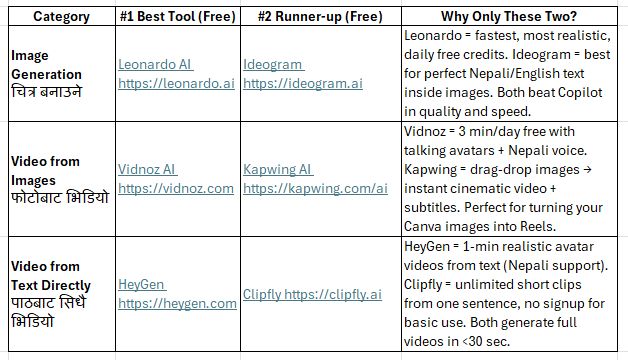
The best news is that the power of this revolution is accessible to everyone, often for free. For any Nepali content creator or business owner looking to test the waters, these three tool categories provide an immediate starting point:
These free tools demonstrate that the power of AI is already in your hands, ready to be leveraged for your complex work and personal IKIGAI projects.
Why This Matters to Nepal
For content creators, filmmakers, and business owners in the Central Region, this technology is a great equalizer.
Global Reach: It provides a cost-effective, powerful tool for globalizing Nepali culture, stories, films, and products. You can produce sophisticated promotional materials showcasing a trekking route or an artisanal product without reliance on expensive imported equipment or crews.
Rapid Iteration: You can test dozens of marketing video concepts in a day, allowing you to instantly determine which message resonates most with your target audience.
Empowerment: The ability to simply describe a world into existence was long reserved for science fiction. Today, that fiction is your reality. The focus shifts from the technical burden of filmmaking to the quality of your ideas and the brilliance of your prompts.
Call To Action (CTA): The most proactive step you can take today is to begin experimenting with the free tools listed above. The time for waiting is over; the time for creation is now.
Bibliography
1. Woli, K.P. (2025). Fasting (A Scientific Guide to Health and Longevity); Trusting the Invisible (A Scientific Guide to Gut Health, Immunity, and a Balanced Life); and Pilgrimage (Transforming Grief to Purpose). (Cited as the primary source for the user's authority and content synthesis).
2. Google DeepMind and similar advanced labs. (2024). Reports on the development and deployment of high-fidelity Text-to-Video Generative AI Models (e.g., Veo, Sora). (Factual Support: State-of-the-art capability).
3. McKinsey Global Institute. (2024). Economic Reports on the impact of Generative AI on Creative Workflows and Productivity. (Factual Support: Business/economic implication).
4. OpenAI / Anthropic / Microsoft. (2024). Public statements and research papers regarding the shift towards multimodal AI and AI Agents. (Factual Support: General AI progress, linked to tech leaders).
***********************************
***********************************
Thursday (2025/12/11)
The Physics of the Soul: Transforming Loss into a Living Legacy
When you lose a piece of your future, the past becomes a place of constant, agonizing revisitation. For me, that seismic rupture happened when we said goodbye to my beloved son, Basanta, forever 27. Every parent who has faced the unspeakable knows the silence that follows—a silence so complete it shatters the very foundations of your life’s purpose.
As a business owner, an academic, and a father, I believed in structure, facts, and logical progress. But grief is not logical; it is a raw, elemental force that defies all existing frameworks. It destroyed my “assumptive world”—the quiet certainty that the future would be better than the past. I was left with a burning question that research could not easily answer: What do you do when your life no longer makes sense?
The answer was found not in a ledger or a lab, but on a path—a pilgrimage.
The Journey to Ikigai is an Act of Remembrance
A pilgrimage is often viewed through a religious lens, but at its core, it is a psychological and sociological necessity. It is a rite of passage—a physical, intentional journey designed to help us navigate profound life transitions. When I started writing Pilgrimage as Remembrance: Finding Ikigai After Loss, I realized the true purpose of the journey was not to forget the pain, but to actively remake meaning in the shadow of loss.
Grief demands we create a new narrative for our lives. The profound walking and quiet contemplation inherent in a pilgrimage offer the perfect liminal space to do this work. It provides:
A Break from the Ordinary: The distance from daily routine allows the mind to process the trauma without the constant interruption of home life.
Physicality as Therapy: The physical challenge of the walk, the simple act of putting one foot in front of the other, is proven to reduce symptoms of anxiety and depression, improving psychological well-being.
A New Coherence: By intentionally dedicating the hardship of the journey to the memory of the lost person—in my case, Basanta—the pilgrimage becomes an act of active remembrance. The goal is not to find fleeting happiness, but enduring psychological fulfillment, or Eudaimonia.
Finding the Courage to Begin Again
I realized that the goal of my pilgrimage was to find a new Ikigai—the Japanese concept of a reason for being—that was strong enough to carry the weight of Basanta’s absence. My grief became the fuel, and the book became the legacy. My commitment was to transform a father's pain into a universal roadmap for healing.
As I wrote in the book: "Some stories are written with ink. Others are written with tears, breath, and the quiet courage to begin again."
If you are struggling to find your way forward, understand this: your journey to purpose must begin with intentional steps. Your sorrow can become your greatest motivator. Your loss can be transformed into a living legacy of love and service to others. Let my book be your guide on that purposeful path.
Start your journey of healing and purpose.
Read Pilgrimage as Remembrance today.
Explore wellness, travel, and meaningful living.
exploreikigai@gmail.com
+9779707095679
© 2025. All rights reserved.